Average Reviews:

(More customer reviews)I'll be honest here. I was purchasing a completely unrelated book, and I needed to spend a few more bucks to get free shipping at Amazon. Having just ordered a PICAXE development board and a few PICAXE chips to play with, I did a quick search and found this book. I have already bought and studied "Programming and Customizing the PICAXE Microcontroller" book by David Lincoln (also highly recommend) so I didn't think I needed another PICAXE book. But I bought it anyway.
And I'm glad I did.
Mr. Hackett did a fine job on this book. It is well written, very illustrative (although the publisher could have lightened a number of the illustrations, many were very dark and you had to squint), and follows a very nice outline.
What impresses me the most, besides the thoroughness of the programming information, is the design suggestions that he made. I have, since I was 10 years old (I still have that first breadboard 25 years later), been a breadboarder. I have built and modified many circuits on breadboards. It is a valuable skill, one that can only come from experience... but it can also get tedious. That's why I really like the development boards that are available. I have been using a PICAXE development board (google AXE091) for a few days and really enjoy it, and highly recommend it. It's also why I REALLY like the Arduino with the associated shields for it. But what impresses me with this book is Mr. Hackett's stripboard techniques. First you breadboard a peripheral (LED display, switch, etc) and then, since it is something you will likely use again and again, you can save time in the future by making a stripboard version that plugs into your breadboard. Very nice. But even that can get tedious after a while... so guess what? When you have developed that particular skill, and want to save time, you can actually purchase professionally etched PC boards from his website to make some of these peripherals.
I also really liked his logic probe in a test tube project. I intend to make one myself. It reminds me of our high school electronics class when we all made voltage testers, put them in a glass test tube, filled it with clear epoxy, and then broke the glass off... although Mr. Hackett's design simply encloses the probe in a plastic test tube... nice design.
I recently wrote a poor review of "PIC Programming for Beginners" by Mark Spencer and published by the American Radio Relay League. I stated that the book was not for beginners and I suggested that the ARRL publish a three volume set, the first being a book about digital electronics (TTL/CMOS logic, etc, which I find an essential prerequisite to micros... then Volume 2 would be a book about the PICAXE, and Volume 3 would be the book introducing the PIC and assembly code. "PICAXE Microcontroller Projects for the Evil Genius" would be my Volume 2 of this set.
Nice work Mr. Hackett!
Click Here to see more reviews about: PICAXE Microcontroller Projects for the Evil Genius
WHIP UP SOME FIENDISHLY FUN PICAXE MICROCONTROLLER DEVICES
"Ron has worked hard to explain how the PICAXE system operates through simple examples, and I'm sure his easy-to-read style will help many people progress with their PICAXE projects."
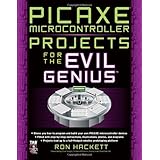
This wickedly inventive guide shows you how to program, build, and debug a variety of PICAXE microcontroller projects. PICAXE Microcontroller Projects for the Evil Genius gets you started with programming and I/O interfacing right away, and then shows you how to develop a master processor circuit.
From "Hello, World!" to "Hail, Octavius!"All the projects in Part I can be accomplished using either an M or M2 class PICAXE processor, and Part II adds 20X2-based master processor projects to the mix. Part III culminates in the creation of Octavius--a sophisticated robotics experimentation platform featuring a 40X2 master processor and eight breadboard stations which allow you to develop intelligent peripherals to augment Octavius' functioning. The only limit is your imagination!
PICAXE Microcontroller Projects for the Evil Genius:
Features step-by-step instructions and helpful photos and illustrations
Allows you to customize each project for your purposes
Offers all the programs in the book free for download
Removes the frustration factor--all required parts are listed, along with sources
Build these and other devious devices:
Simple mini-stereo jack adapter
USBS-PA3 PICAXE programming adapter
Power supply
Three-state digital logic probe
20X2 master processor circuit
TV-R input module
8-bit parallel 16X2 LCD board
Serialized 16X2 LCD
Serialized 4X4 matrix keypad
SPI 4-digit LED display
Countdown timer
Programmable, multi-function peripheral device and operating system
Octavius--advanced robotics experimentation platform
L298 dual DC motor controller board
Visit www.JRHackett.net to learn more.
 Get 39% OFF
Click here for more information about PICAXE Microcontroller Projects for the Evil Genius

0 comments:
Post a Comment