Average Reviews:

(More customer reviews)There's probably some stuff in here that would be useful for a manager who is completely clueless, but I didn't find much that would be useful insight for someone further along than that. I gave it a few chapters, because a friend I respect recommended it, but then gave up. I guess the book is okay for what it is, but it isn't likely to make any lasting improvement in your relationship with your employees. It generally comes from a perspective that has been somewhat popular in recent years, to the detriment of business, one that says:
- Process is more important than substance.
- Management can be detached from leadership.
- Management is more about skill than about character.
Employees follow and build loyalty to leaders who lead, not administrators who manage. When you've proved yourself as a leader, when you've proved (by consistent actions over time) to your employees that you really have their best interests at heart, and when you've shown that you'll work with those who want to improve, but will deal decisively with those who poison the work environment, then amazingly enough, employees tend to start doing what they ARE supposed to do.
I'd recommend skipping this one and picking up a copy of Leadership as a Lifestyle, by Hawkins, instead.
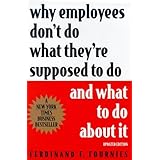
Click Here to see more reviews about: Why Employees Don't Do What They're Supposed To Do and What To Do About It
Invaluable." --SUCCESS. "In simple, straightforward language, Fournies offers practical solutions to the problems of employee performance ... [This book] should be on the desk of anyone who manages others."--ENTREPENEUR.THE TOP 10 REASONS EMPLOYEES DON'T DO WHAT THEY'RE SUPPOSED TO DO: 10.They don't know why they should do it; 9. They don't know how to do it8. They don't know what they are supposed to do7. They think your way will not work6. They think their way is better5. They think something else is more important5. They think they are doing it4. They are punished for doing it3. They are rewarded for not doing it2. It's beyond their personal limits1. No one could do itThis book tells you how to avoid or handle each situationÑand the 6 other reasons that comprise the total list of reasons employees don't do their jobs. Universally praised and a perennial best seller, this book made The New York Times business bestseller list in early 1998--10 years after it came out! Why? Competition to attract and keep good employees is fiercer than ever. Today's employers need the no-nonsense people-management skills this book teaches. Based on real experiences of 25,000 managers surveyed by a Columbia Graduate School of Business professor, this results-oriented guide--newly updated for todayÕs changing workplace--provides proven, straightforward methods that work on real jobs, in real businesses, in the real world.This updated edition also gives you new input from 5000 additional managers, plus more help with temp workers, service industries, flex time, computers, telecommuting, stress, and safety!


0 comments:
Post a Comment