Average Reviews:

(More customer reviews)Read this book first before wasting your money on other books. I just finished my first read through of this book. It was amazing. I learned more about how the Japanese language is structured in a few days than I have from other books in months.
Many students of Japanese just need basic information at the beginning in order to be productive in their studies.
Gene Nishi gets straight to the point, starting with the basic sentence structure, adding more information as the book progresses. And since everything complex is made up of simple things, you can start to see how a complicated Japanese sentence can be analyzed and understood. After reading through this book, I could get the "gist" of basic to intermediate Japanese sentences even though my vocabulary is yet not up to snuff. I could just tell that "someone gave something to someone else at such and such time", for example. While that may sound trivial, my abilities will only increase as I engage in Japanese conversation and read the Japanese papers, because the blanks will be filled in from the context, just like any other language acquisition process. The point is, I now know where the blanks are,thanks to this book!
Gene Nishi also does an excellent job of targeting this book to a particular audience: adult professionals who need to conversate with Japanese adult professionals(although this book would work for any student). Right now, I do not need to know all of the embellishments and ornaments in everyday Japanese language. I don't have the time. I just need to be able to have relatively educated conversations with a native speaker. This book has all of the tools to enable me to get the solid foundation needed to achieve that goal. He describes the different classes of adjectives, verbs and some of the more common particles(wa, ga, ni, de, no) in a clearer manner than anywhere else. Gene also said that learning the 1006 Kanji taught to Japanese grade schoolers would cover 90% of those used by newspapers. That was quite a relief! I had heard there were 20000 of them! If I learn 3 a day, I'm on my way. See how this book reduces some of the complications? Finally, Nishi's organization of this book makes a lot of sense. He starts from simple examples and works up to more complicated ones.
A few notes, while this book is an excellent start, once you finish it, to get the deepest understanding you will need to look at other books for the following reasons:
1. Understanding the Japanese language from a linguistic perspective. A few of Gene's descriptions do not match what I've learned elsewhere(for example, the Japanese characters or "Mora" are not divisible! You should not think of the particle "no" as a combination of the n sound and the o sound. To the Japanese, the particle "no" is one indivisible unit.)
2. Mastering the Kana
3. Learning Kanji
4. Understanding the tonal structure of spoken Japanese
5. Doing exercises! This is not an exercise oriented book. The books by Eleanor Jorden are the best in that area. I plan on going that route after mastering this book.
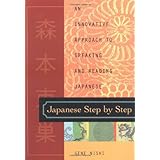
Click Here to see more reviews about: Japanese Step by Step : An Innovative Approach to Speaking and Reading Japanese
This self-study text offers a breakthrough approach for beginning learners of Japanese, as well as an indispensable reference for intermediate students. The unique study method in Japanese Step By Step teaches how to construct Japanese sentences, from the simplest to the most complex, using an easy-to-follow, step-by-step method. Also contains flow charts for verb conjugations and derivations.


0 comments:
Post a Comment