Showing posts with label linguistics. Show all posts

Sunday, July 8, 2012

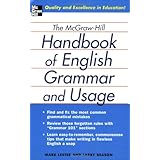
The McGraw-Hill Handbook of English Grammar and Usage Review

The McGraw-Hill Handbook of English Grammar and Usage
Average Reviews:

(More customer reviews)
Broadly speaking, this is an excellent handbook, a superb handbook. The concepts are explained clearly and the examples are very instructive. What is in the handbook is treated very lucidly and thoroughly and with considerable depth. I personally was impressed at the depth and detail in which some of the grammar is covered.
The only real problems with the handbook don't concern what is in the book--it's what isn't. There are nuances in subject-verb agreement which aren't included, areas such as impersonal expressions are absent, and there is no mention of the subjunctive. If one is preparing for the TOEFL, this is a good book to get but I would not make it the only text you study, since it is not exhaustive by any means.
Still, there is a good amount of very useful information excellently explained here. I would offer a warm qualified recommendation to ESL students, one a bit nuanced. For the ESL student with absolutely no interest in the subject, who feels that study of English in general is one big long painful injection in the gluteus maximus, a tortuous experience only to be endured and not enjoyed in any way, this book is going to come off nebulous and long-winded. Granted, the book does not give one simply the bare bones of a concept and leave enough alone; for the student who wants merely to ratchet together enough knowledge to pass a few tests and move on, this book might be a bit too dedicated to its subject material. For the student with some real interest in learning English and learning it well, however, this book definitely rewards a patient and attentive reader because ideas are not merely presented but amply explained, and in handsome detail. If one is preparing for the TOEFL, be sure to buy the TOEFL preparation book by Barron's, which will explain a host of tricks presented on the test but which are notably absent in this book. This book is excellent for the concepts it covers, but it doesn't cover enough for the testtaker, so be sure to purchase other sources for your test preparation.

Click Here to see more reviews about: The McGraw-Hill Handbook of English Grammar and Usage


Those pesky dangling modifiers, split infinitives, and comma splices­­they infect our spoken and written language with such frequency that even native English speakers find it difficult to determine what's right and what's wrong!

The McGraw-Hill Handbook of English Grammar and Usage shows you how to fix these everyday English language mistakes. With commonsense, easy-to-remember usage tips throughout, this handbook features incorrect and correct grammatical examples, a short review of basic grammar, a glossary, and more.


Buy NowGet 36% OFF

Click here for more information about The McGraw-Hill Handbook of English Grammar and Usage

Read More...

Monday, March 5, 2012

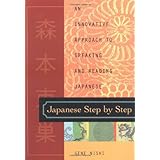
Japanese Step by Step : An Innovative Approach to Speaking and Reading Japanese Review

Japanese Step by Step : An Innovative Approach to Speaking and Reading Japanese
Average Reviews:

(More customer reviews)
Read this book first before wasting your money on other books. I just finished my first read through of this book. It was amazing. I learned more about how the Japanese language is structured in a few days than I have from other books in months.
Many students of Japanese just need basic information at the beginning in order to be productive in their studies.
Gene Nishi gets straight to the point, starting with the basic sentence structure, adding more information as the book progresses. And since everything complex is made up of simple things, you can start to see how a complicated Japanese sentence can be analyzed and understood. After reading through this book, I could get the "gist" of basic to intermediate Japanese sentences even though my vocabulary is yet not up to snuff. I could just tell that "someone gave something to someone else at such and such time", for example. While that may sound trivial, my abilities will only increase as I engage in Japanese conversation and read the Japanese papers, because the blanks will be filled in from the context, just like any other language acquisition process. The point is, I now know where the blanks are,thanks to this book!
Gene Nishi also does an excellent job of targeting this book to a particular audience: adult professionals who need to conversate with Japanese adult professionals(although this book would work for any student). Right now, I do not need to know all of the embellishments and ornaments in everyday Japanese language. I don't have the time. I just need to be able to have relatively educated conversations with a native speaker. This book has all of the tools to enable me to get the solid foundation needed to achieve that goal. He describes the different classes of adjectives, verbs and some of the more common particles(wa, ga, ni, de, no) in a clearer manner than anywhere else. Gene also said that learning the 1006 Kanji taught to Japanese grade schoolers would cover 90% of those used by newspapers. That was quite a relief! I had heard there were 20000 of them! If I learn 3 a day, I'm on my way. See how this book reduces some of the complications? Finally, Nishi's organization of this book makes a lot of sense. He starts from simple examples and works up to more complicated ones.
A few notes, while this book is an excellent start, once you finish it, to get the deepest understanding you will need to look at other books for the following reasons:
1. Understanding the Japanese language from a linguistic perspective. A few of Gene's descriptions do not match what I've learned elsewhere(for example, the Japanese characters or "Mora" are not divisible! You should not think of the particle "no" as a combination of the n sound and the o sound. To the Japanese, the particle "no" is one indivisible unit.)
2. Mastering the Kana
3. Learning Kanji
4. Understanding the tonal structure of spoken Japanese
5. Doing exercises! This is not an exercise oriented book. The books by Eleanor Jorden are the best in that area. I plan on going that route after mastering this book.

Click Here to see more reviews about: Japanese Step by Step : An Innovative Approach to Speaking and Reading Japanese


This self-study text offers a breakthrough approach for beginning learners of Japanese, as well as an indispensable reference for intermediate students. The unique study method in Japanese Step By Step teaches how to construct Japanese sentences, from the simplest to the most complex, using an easy-to-follow, step-by-step method. Also contains flow charts for verb conjugations and derivations.


Buy Now

Click here for more information about Japanese Step by Step : An Innovative Approach to Speaking and Reading Japanese

Read More...

Wednesday, February 22, 2012

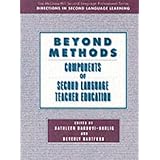
Beyond Methods: Components of Language Teacher Education Review

Beyond Methods: Components of Language Teacher Education
Average Reviews:

(More customer reviews)
This book covers a variety of ELL topics. Each chapter presents information which is research based and immediately applicable to the classroom. I have used it constantly since being introduced to it four years ago.
Topics include syntactic theory, pragmatics, reading research theory and assesment. It is edited by the outstanding researcher Bardovi-Harlig.
This is an excellent book for TESOL grad students, ESL/EFL teachers who wish to expand their knowledge and those interested in becoming familiar with the jargon of the profession.

Click Here to see more reviews about: Beyond Methods: Components of Language Teacher Education

Beyond Methods introduces teachers to the research of second language acquisition as it applies to the classroom and offers a theoretical basis for making decisions about such things as methods, syllabus design and assessment.

Buy Now

Click here for more information about Beyond Methods: Components of Language Teacher Education

Read More...

Tuesday, December 20, 2011

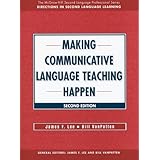
MAKING COMMUNICATIVE LANGUAGE TEACHING HAPPEN Review

MAKING COMMUNICATIVE LANGUAGE TEACHING HAPPEN
Average Reviews:

(More customer reviews)
I read this as a master's candidate in a TESL in Washington, DC. I found it relatively easy to read. Still, it's academically written and focuses on theories and research done on second language acquisition. Topics covered include grammar in communicative language, speaking, reading and writing. This book is for those who want to take a step forward into academia and research in teaching methodology.

Click Here to see more reviews about: MAKING COMMUNICATIVE LANGUAGE TEACHING HAPPEN

Praised for its fresh and informed discussion of language instruction and language acquisition, the first edition of Making Communicative Language Teaching Happen was recognized by the Modern Language Association as one of the twenty most influential methods textbooks. The authors are both internationally recognized scholars in the field of second language acquisition research and have also written numerous successful language textbooks. The guiding principle of Making Communicative Language Teaching Happen is the premise that communication is the expression, interpretation, and negotiation of meaning, and not simply oral expression. Following that framework, Making Communicative Language Teaching Happen helps instructors develop communicative classroom environments that blend listening, speaking, reading, and writing.

Buy Now

Click here for more information about MAKING COMMUNICATIVE LANGUAGE TEACHING HAPPEN

Read More...

Tuesday, November 15, 2011

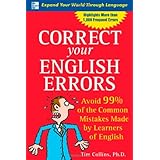
Correct Your English Errors: How to Avoid 99% of the Common Mistakes Made by Learners of English Review

Correct Your English Errors: How to Avoid 99% of the Common Mistakes Made by Learners of English
Average Reviews:

(More customer reviews)
This is a fantastic resource for English learners. The author has admirably condensed decades of his experience with teaching English (and teaching teachers of English) into an easy-to-use guide that explains the commonest errors, why they're wrong, and how to correct them. What really shines through on every page is Dr. Collins' empathy for and patience with speakers of other languages: his explanations are straightforward and uncluttered: he just wants the reader to understand what the problem is and how to correct it. I recommend this book to any learner of English who wants to "go native," speaking and writing as if English were your first language.

Click Here to see more reviews about: Correct Your English Errors: How to Avoid 99% of the Common Mistakes Made by Learners of English


Speak and write English as if it were your native tongue!

Are you tired of making the same mistakes in English again and again? End the bad habits that can leave the people you talk to confused. Correct Your English Errors warns you of hundreds of typical errors learners make and explains the reasons behind the mistakes, so you can correct yourself in the future.

Improve your English skills with this fun and comprehensive guide and avoid all the common mistakes, such as:

Mispronouncing and misspelling words
Applying your native language's grammar patterns to English
Putting verbs in the wrong tense
Using incorrect prepositions in expressions
Confusing subject-verb agreement

Correct Your English Errors offers exercises covering all parts of grammar and provides review passages to check that you are error-free. Soon, biting your nails will be your only bad habit!


Buy NowGet 40% OFF

Click here for more information about Correct Your English Errors: How to Avoid 99% of the Common Mistakes Made by Learners of English

Read More...